
Revolutionize UAV 3D print with HP Multi Jet Fusion
Struggling with challenges in your UAV 3D printing process?
Flight Performance
Looking to boost aerodynamics and elevate flight performance?
Redesign and Testing
Experiencing delays due to long redesign and retooling cycles?
Customization
Need to efficiently produce complex or customized drone components??
Cost
Dealing with high tooling costs, specially for low-to mid volume production?
Scaling up
Facing difficulties scaling up to meet growing demand?
If you answered yes to any of these, HP Multi Jet Fusion (MJF) can help.
Discover the HP MJF advantages for 3D printing UAVs:

-
Performance: lightweight strength meets functional design
- In drone manufacturing, every
gram counts. HP Multi Jet Fusion (MJF) enables the production of
lightweight yet mechanically robust components that can withstand
the stresses of flight, vibration, and environmental exposure.
Unlike traditional manufacturing methods—which often require compromises in geometry or material distribution—HP MJF offers true design freedom, enabling engineers to optimize parts for aerodynamics, thermal management, and structural efficiency.
Key performance advantages include:
- Isotropic mechanical properties: Parts exhibit consistent strength in all directions, unlike FDM or laminated composites, which are often weaker along the Z-axis.
- No support structures: This allows for cleaner internal channels, integrated features, and reduced post-processing.
- Precision and repeatability: Ideal for mission-critical components like housings, brackets, and aerodynamic surfaces.
This makes HP MJF particularly well-suited for UAVs operating in demanding environments, where reliability and performance are non-negotiable.
Show more

-
Scalability: from prototype to production without compromise
- One of the most powerful
aspects of HP MJF is its ability to scale seamlessly. Whether you're
producing a single prototype or thousands of end-use parts, HP MJF
delivers industrial-grade consistency and high throughput—without
the need for tooling or mold changes.
For drone manufacturers, this means:- Faster time-to-market: Iterate and validate designs quickly, then move to production without switching technologies.
- Cost-effective low- and mid-volume production: Avoid the high upfront costs of injection molding or composite tooling.
- Supply chain flexibility: Produce parts on demand, closer to the point of use - reducing inventory and logistics complexity.
This scalability is especially valuable in a market where product lifecycles are short, and customization or mission-specific variants are increasingly in demand.
Show more

-
Rapid iteration: accelerating innovation in UAV design
- Innovation in the drone
industry moves fast—and so should your development process. HP MJF
empowers teams to iterate quickly and confidently, using the same
materials and processes from concept through production.
This agility enables:- Design-test-learn cycles in days, not weeks
- Functional prototyping with production-grade materials
- Continuous improvement based on field data or customer feedback
Because HP MJF uses the same platform and materials across all stages, there's no need to redesign parts for different manufacturing methods. This reduces friction in the development process and allows teams to focus on what matters most: building better drones, faster.
Show more
See how innovative brands are transforming their UAV 3D printing with HP Multi Jet Fusion (MJF) technology


Pushing the limits of drone design with ultra-light airframes
Specializing in advanced aerial surveillance and environmental monitoring, The Eye Above aimed to enhance the design of its ground-breaking drones by creating an airframe with ultra-thin walls, structured into cells to achieve an optimal strength-to-weight ratio.
Deep-dive: How HP MJF is transforming UAV 3D printing across industries
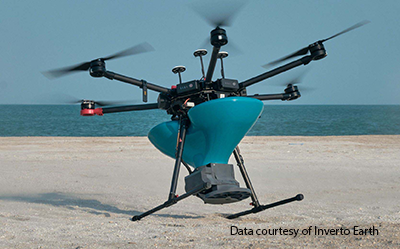
From ecological restoration to modular underwater vehicles and high-performance aircraft systems, 3D printed drones are redefining what's possible in UAV design and production. Powered by HP Multi Jet Fusion (MJF) technology, companies like Inverto Earth, Framework Robotics, and UAV Works are accelerating development, reducing costs, and unlocking new levels of customization and performance.
Ready to order your parts?
Whether you're prototyping or scaling production, upload your 3D model, get an instant quote, and order in just a few clicks.
Ready to take next step?
Connect with the HP Drones team—a group of experts ready to explore your UAV use case and help bring your vision to life.
Frequently Asked Questions: 3D Printing UAVs with HP MJF
- Inverto Earth uses drones with HP MJF-printed components to plant mangrove seeds across diverse and challenging environments like Indonesia and the Middle East. Their drones are equipped with custom payload delivery systems that can handle over 60 types of seeds-thanks to the design flexibility and durability of HP MJF parts.
- Blueflite integrates HP MJF-printed parts into its logistics drones, which are designed to carry medical supplies, industrial tools, and other critical payloads. Their drones feature modular payload bays and custom landing gear optimized for performance and weight reduction—both essential for safe and efficient delivery operations.
In contrast, HP Multi Jet Fusion (MJF) technology offers significant advantages for drone development. It enables greater design flexibility, allowing engineers to create complex, lightweight geometries that are difficult—or even impossible—to achieve with traditional composite manufacturing methods. Additionally, HP MJF supports rapid prototyping and short production cycles, which are ideal for iterative design processes and accelerating time-to-market.
Ultimately, the choice depends on the specific performance and production requirements of the drone application, but HP MJF provides a compelling alternative when agility, complexity, and cost-efficiency are key considerations.
A practical example is Vecros, a drone startup that initially used FDM to prototype parts for its autonomous drone, Athera. As the design matured, they transitioned to HP Multi Jet Fusion to meet the demands for higher dimensional accuracy, better surface finish, and more consistent mechanical properties—key factors for reliable performance in the field.
This shift reflects a broader trend where manufacturers adopt HP Multi Jet Fusion printing technology when moving from prototyping to production, particularly in applications like UAVs where precision, strength, and repeatability are critical.